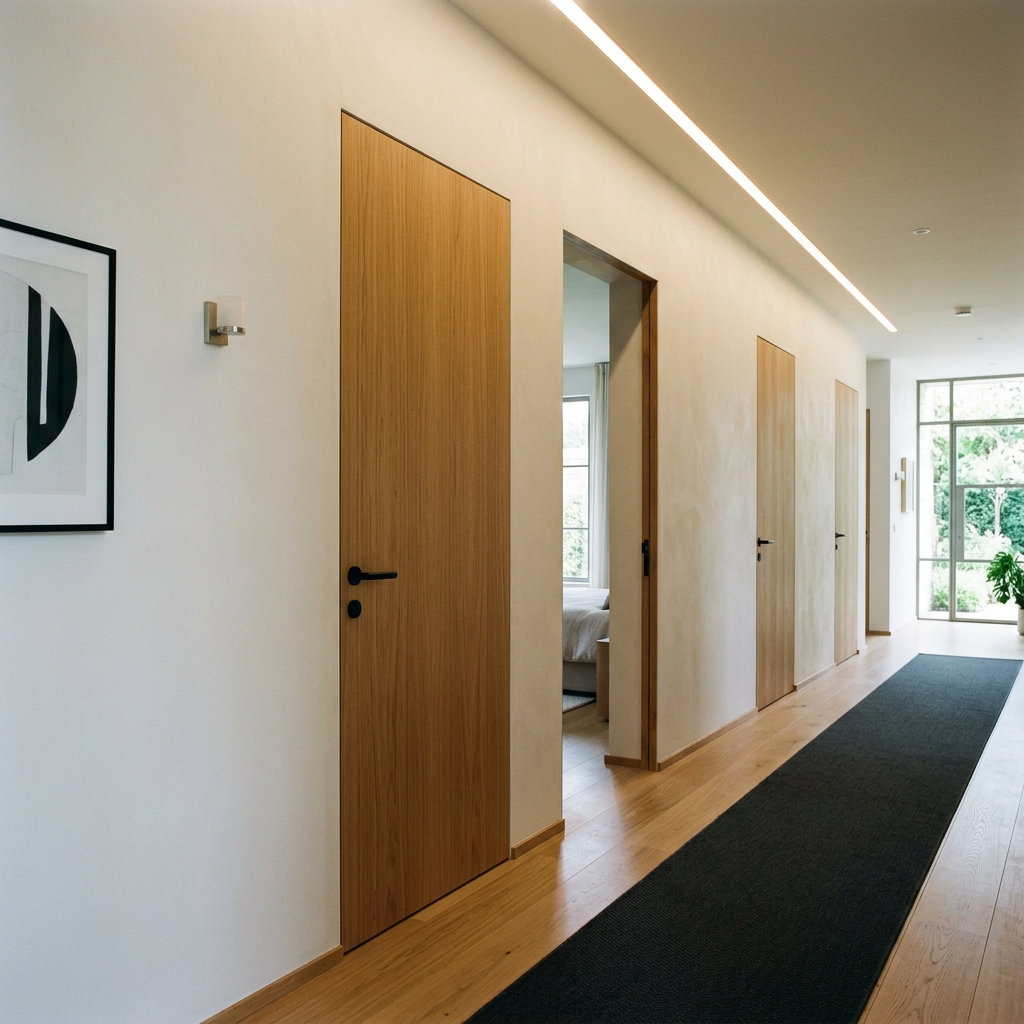
It is incredibly common to view interior doors purely as functional necessities—they close off the bathroom, hide the messy closet, and give us privacy. But if you step back and look at the sheer square footage they occupy, you realize they are essentially large, moving pieces of wall art.
Treating your interior doors as design statements rather than invisible barriers is one of the most effective ways to elevate the entire feel of your home. It instantly signals that a space is custom, thoughtful, and fully finished.
Here is how you can transform your interior doors from basic builder-grade to stunning focal points.
1. The Power of Unexpected Paint
The standard default for interior doors is “trim white,” designed to blend in and disappear. But what if you forced them to stand out?
The Drama of Dark Doors: Painting interior doors black, charcoal, or deep navy is a massive trend for a reason. Dark doors ground a room, hide scuff marks brilliantly, and make any ceiling look taller by drawing the eye up.
Color Blocking: If you have a neutral hallway, painting the doors a muted sage green, a warm terracotta, or even a soft dusty pink can inject personality into an otherwise transitional space.
The Monochromatic Wrap: For a moody, immersive vibe, paint your door, the door frame, the baseboards, and the walls all the exact same color.
2. Upgrading the “Jewelry” (Hardware)
If doors are the outfit, the hardware is the jewelry. You can keep a standard six-panel door but make it look expensive simply by swapping out cheap, hollow-core knobs.
Substantial Weight: A heavy, solid brass or matte black lever feels completely different in the hand than a lightweight aluminum knob. That tactile experience translates to a perception of quality.
Backplates: Adding a tall, decorative backplate behind the knob or lever instantly adds a touch of vintage elegance or modern industrialism, depending on the finish.
Don’t Forget the Hinges: If you upgrade to beautiful unlacquered brass knobs, make sure to swap out those old silver hinges to match. Cohesion is key.
3. Architectural Swaps
Sometimes, paint and hardware aren’t enough, and a room calls for a completely different kind of barrier. Swapping a solid door for a statement door changes the architecture of the space.
French Doors: Adding double French doors to a home office or a dining room creates a grand entrance and allows natural light to flow between rooms while still providing a sound barrier.
Reeded or Fluted Glass: If you need privacy but want light, doors with reeded or frosted glass offer beautiful texture and a high-end, mid-century modern aesthetic.
Arched Doors: While this requires altering the drywall and framing (a more intense renovation), an arched doorway softens the hard angles of a hallway and adds an undeniable Mediterranean or Tudor charm.
Pocket or Barn Doors (Done Right): When space is tight, swapping a swinging door for a sliding one is highly functional. To make it a statement, use salvaged vintage doors, sleek modern glass panels, or richly stained solid wood rather than standard hollow-core slabs.
4. Playing with Texture and Materiality
Who says a door has to be perfectly smooth? Texture catches the light and adds depth to a room.
Natural Wood Tones: Stripping old doors down to their raw wood or installing new solid white oak doors brings warmth and organic texture that breaks up stark drywall.
Molding and Millwork: If you have flat, hollow-core doors, you can use trim to create geometric patterns or classic paneling directly on the door’s surface before painting it.
A Reality Check on Budget: Solid wood and custom architectural doors are expensive. If you are on a tight budget, focus your energy on the paint and hardware. You will be shocked at how a $40 can of premium paint and a $30 solid brass knob can completely disguise a $60 hollow-core door.
Are you looking to upgrade your existing doors with some fresh paint and new hardware, or are you considering completely replacing them with a new architectural style like glass or solid wood?